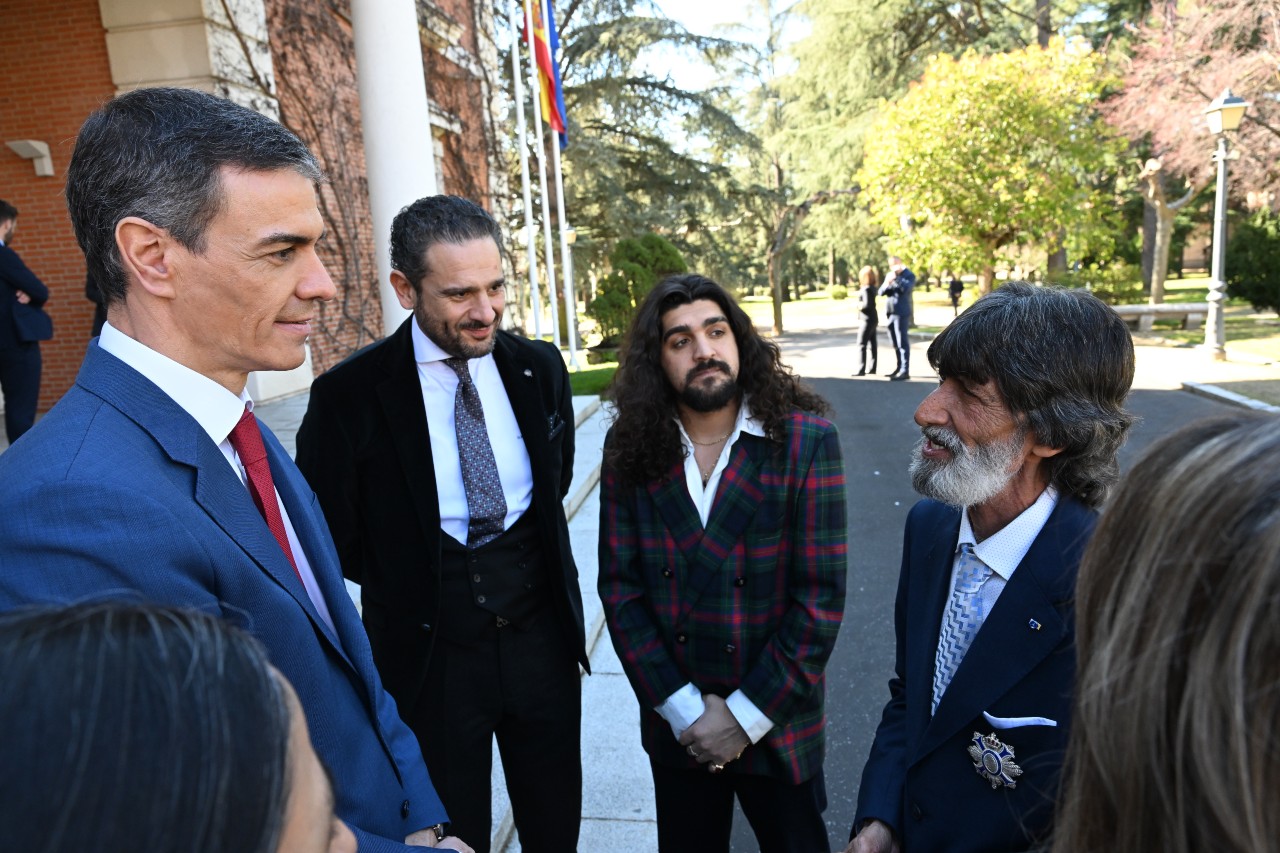
Pedro Sánchez’s support for pop music has stopped being news. It’s been 10 years since he shared his first indie music playlists, and almost 3 years ago he talked about Beach House, Kae Tempest or Fred again on the La Pija and La Quinqui podcast. He has received artists as diverse as Jota de Los Planetas, Judeline or El Chojín in Moncloa, he has decorated Sílvia Pérez Cruz, and we have seen photos of him with profiles as unlikely as Javiera Mena or Jimena Amarillo.
He currently recommends a song (and a book) every weekend via TikTok. It hits everything, from Cala Vento to Vera Fauna, through things as strange as Restinga, and so on until you lose count. Someday not too far away -or yes, who knows- we will miss the president of our country supporting all this: it is a shame to take it for granted.
The event organized this Saturday at the Moncloa Palace was neither strictly musical nor pop. It has been 600 years since the arrival of the gypsy people to the Iberian Peninsula (601, actually), so a tribute called “Gelem Gelem” has been organized in which Pepe Habichuela, Lolita, Teresa Peña “La Lebrijana”, Emilio Fernández de los Santos “Caracafé”, and Juan de Dios Ramírez Heredia have been decorated. Among the performances, Lela Soto in the same ‘Gelem Gelem’, Israel Fernández in a tribute to Camarón, and María Terremoto and Anabel Valencia stealing the show with a heartfelt tribute to ‘Persecución’ by Juan Peña «El Lebrijano», coinciding with its 50th anniversary. It was a pioneering album as early as 1976.
“Persecution” has been one of the most repeated words in a ceremony that was torn between the solemnity of the Palace and the most Spanish spontaneity, whether gypsy or paya: you can see on networks that Israel Fernández has ended up presiding over the Council of Ministers.
See this post on Instagram
In Moncloa, punctuality is strict, at 11:00 Pedro Sánchez and Begoña Gómez enter through the door of the assigned room, 8 minutes before everyone has to be seated, and very few moments after 12:00, the event is over. There is a protocol for when the artists have to say something and give thanks, and a maximum time for speeches that is not announced but is perceived in the environment. Let the Goyas take note. The writer and activist Noelia Cortés acts as master of ceremonies, who dedicates the event to the death of Rafael Amador; The second vice president of the State Council of the Gypsy People, Carmen Santiago Reyes, speaks for just under 5 minutes, and Sánchez, who intervenes at the end, does not exceed 10.
That rigor does not prevent us from losing emotion along the way. The entire audience stands up for the gypsy anthem ‘Gelem, Gelem’; The singer Israel Fernández, Diego del Morao on the guitar, Ané Carrasco on the cajon, and El Pirulo and Marcos Carpio on the palmas raise the spirit in the tribute to Camarón; and María Terremoto and Anabel Valencia’s interpretation of the galleys of ‘My Condemnation’ cuts through the hiccups, in which no one even dares to cough.
‘Persecución’ was an album that alternated singing with the narration of the poet Félix Grande’s texts, which spoke of the oppression suffered by the gypsy people throughout the centuries (“The gypsy women and their children / walked alone through the streets / leading to their loneliness / subject to the branches”). ‘My sentence’ bled when he said that “my strongest pain was for my children to grow up and know this death.” 50 years later, María and Anabel’s voices resonate even in the last corner of the Portavoz Building. At the end they themselves show their respect for the tremendous song, something “so big for the gypsy people”, but with the entire audience in their pockets. After Sánchez’s intervention, the end of the party unites all the artists, by bulerías, on stage.

The speeches combined the value of the gypsy people, such as the Flores, with their influence on artists such as Lorca, Picasso or Sorolla. Carmen Santiago had declared that “to talk about the gypsy people is to talk about music, singing, dancing, flamenco, cultural heritage and humanity” because “flamenco would not be what it is without the gypsies.” But above all it was a day of social demands. “Our history is a story of persecution and resistance, and also an example of cultural survival, dignity and pride that has been maintained from generation to generation.” Santiago thanked Moncloa for “this act of justice and vindication”, although remembering that public policies still have a lot to do because “inequalities in housing, health and education” persist. “Not one child without schooling,” he asked.

Sánchez, with the ability to smile for an almost disturbing consecutive hour, picked up the gauntlet by underlining the importance of education, dedicating a large part of his speech to the “double ceiling” that Roma women must break, and leaving a possible headline for agencies, after his “beef” with Elon Musk and other oligarchs: “Celebrations such as April 8, International Day of the Gypsy People, or the commemoration of the “Samudaripen”, that is, the genocide of the people gypsy at the hands of Nazism, contribute to making your history visible to our society. They acquire a very special relevance because hate speech unfortunately rages like never before on social networks. We want to say that they will always have us in front of them. “We are on the side of coexistence and coexistence.”
He also did not fail to remember an anecdote: when he saw Pepe Habichuela perform in a restaurant in a town in Almería with his family. Lela Soto had even addressed him with “Thank you, Pedro, for everything you do.” And Noelia Cortés, who assured that the president was there “because he was excited and not out of commitment,” ended up telling him: “we are going to call you Primo Pedro.”
José Antonio Carmona “Pepe Habichuela” was the one who received the most heat from the public, with everyone on their feet to the despair of the photojournalists, but it was Elena Furiase who knew how to get some laughs. His mother, Lolita, had not been able to go because she had a show in Galicia, but she had sent a video. After his speech “I don’t want to make an apology for the gypsies, we are good, we are bad, we are like you”, it occurred to him to say that his daughter was not a gypsy, “only in a room”, to which Furiase, from the audience, shouted back “Yes, I am!”, awakening widespread laughter. A celebration, then, full of pride, which was attended by several ministers, among others of course the Minister of Equality. Who will be the following?

