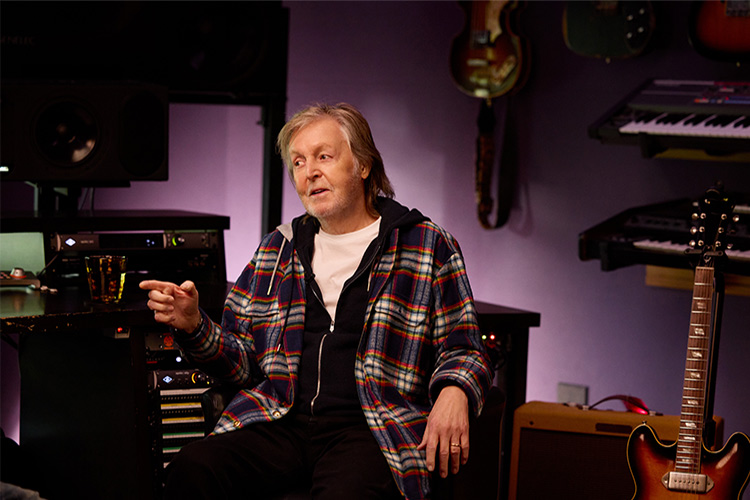
Paul McCartney offers an exclusive interview on the Zane Lowe show about our new job. You can read it below these lines or watch it on video at the end of the text.
From the hand of Apple Music and the Zane Lowe show comes the interview with Paul McCartney himself, one of the great living legends in the history of pop, and which you can read right here. In it, the artist tells curiosities about his career, so we recommend that you don’t miss it. We present it courtesy of Apple Music.
Paul McCartney tells Apple Music about hitchhiking with George Harrison and John Lennon
I used to hitchhike quite a bit. Because in those days you could. And there was no danger involved. And I think it must have been my idea to suggest first to George and then to John, that we hitchhike, because I can’t imagine either of them saying to me, “We should go here…”. Sounds like one of my stupid ideas. So George and I took a couple of very nice trips. This was going to be to Wales…So George and I, when we went to Wales that way, we took our guitars and, being from Liverpool, we thought we were big city boys. You know, arriving in Wales with your guitar. And we played a bit in the pub. I thought it was really cool for the group because you really got to know the other person on a hitchhiking trip, you know?
The way we did it was that we never knew where we were going to stay, it’s kind of a characteristic of my life. I just do that. Just go. “Hey, we’ll find somewhere.” And then, around five o’clock every day, we’d say, “We’d better find a place now,” you know. We were going around looking for bed and breakfasts.
Paul McCartney talks on Apple Music about staying close and enjoying life even in the public eye
I remember once, in the early days of The Beatles, we were recognized almost everywhere, but Ringo and I went on holiday with our girlfriends to Greece and no one knew us. So it was like, “This is great. Wow. We have to come back here more often, even when we get really famous. We can always come to Greece and they’ll never recognize us.”
But of course, that didn’t work. And once it stopped working and I realized I was going to be famous my whole life, if I was lucky, I thought, “Okay, time to make a big decision.” Now you can stop and just think that that was wonderful, those great moments with music, and dedicate yourself to something else more anonymous. Or you can move on.
So if you move forward, you better develop some kind of strategy. You’re already in this. I was very lucky with my family from Liverpool. They are the type of people who make others feel comfortable. So I think I learned it just by being part of that family.
What happens today, of course, are photographs. I meet someone and I say, “Oh, I know what he’s going to get.” They have the camera and they are taking it out. But now I have a way of handling it and I say, “Sorry, I don’t take photos. I hope you understand, but I’m having a private evening,” or whatever, I’m with my wife or my kids. And you’d be surprised how well people understand it. So I say, “But I can chat with you.” And you know, Nancy (Shevell) tells me, “You spend more time. You could have just taken the photo.”
And I understand it, because I see someone famous and I want to take a photo, I want a memory. But my phrase is that I tell them: “You know, in Saint Tropez there is a guy in the port who has a monkey. And you can take a photo with the monkey.” And I tell them, the moment I start doing that, you pull out the camera and I feel like that monkey. Because I’m not myself anymore. I am the monkey. And I say that for me it’s important to just be me, not the guy who’s posing.
Paul McCartney talks about his freedom to create music now and recounts a conversation he had with HER
Zane Lowe: I can hear it on this new record, this freedom in the music. So now I understand that you took your time and made the songs when you really had them, and it doesn’t feel forced because it wasn’t, right?
Paul McCartney: Yes, that’s true. I remember meeting HER. She was rehearsing near where we were rehearsing. So we had a few cups of tea together and chatted.
Zane Lowe: She’s amazing.
Paul McCartney: Yes, it is. And she said to me: “Can you decide what goes on your album?” I said, “Yeah, maybe not everyone?” She said no, that nowadays the record company, a representative… and other people tell her: “I don’t think that song is right,” so you end up more guided than you really want, I think.
I remember thinking that I felt sorry for that. So I am free, I am very lucky. But I would always fight for that, because otherwise I don’t see much point in it.
Paul McCartney tells about his writing process on Apple Music
Zane Lowe: So when you pick up a guitar or go to an instrument, have something you want to say and start writing, is the ambition and intention always to finish the song? Is it important to you that it’s not just a verse and a chorus?
Paul McCartney: The problem with phones today is that before you always had to finish something because there was nowhere to put it. Know? You had it in your head, so you had to finish it, and you did. Now I must have more than a couple thousand sketches on my phone because I just leave it there and think, “Okay, I’ll get back to that.” I’ve saved it, it’s fine.
Zane Lowe: But that started with the modern era. Before that you preferred to think: “I have to finish it.” So I guess I’m asking if you don’t have a bunch of songs from before telephones that are unfinished in some way.
Paul McCartney: Now I do have that. Thanks to the luxury of having a phone, if you don’t have much time but you have an idea, you save it. I mean, it’s okay. There are a few on that list of sketches that I’ll finish, because I know, “Oh, that’s a good one,” so I’ll finish it. And there are others that I think are a piano melody. If I’m ever asked to do a soundtrack for a movie, that could be the theme song. I like to save them just in case.
Paul McCartney talks about writing his new song “Days We Left Behind” and remembering “Dungeon Lane”
I enjoyed writing that song. The truth is that I enjoy writing all of them because it is something like playing a game. It’s a fun thing to do, you know, to think “oh, that will fit with that.” “Oh, I can rhyme this with that.” “Oh yeah, that’s good.” And you’re always discovering fun little details.
With that song I started with a little piano riff at the beginning. In the end we played it with guitar. But it started out as just this little piano riff. I thought, “That’s good, I like it. It’s an introduction. It has good notes.” And then I got to the photos, to this idea of looking back.
And really it should have been something like “looking at black and white memories from my past.” But I changed it to “black and white memories looking back” and suddenly everything clicked. So I thought, “Well, that’s good.” So I was already committed to the idea of memories of my past.
So it’s cool because then you’re like, “Okay, what am I thinking?” Smoky bars, cheap guitars. My first guitar was a Rosetti Lucky Seven that I bought in Liverpool. And when I took it to Hamburg it broke. It was a cheap, bad little thing that just broke. So well… cheap guitars…
And then there’s “The Boys of Dungeon Lane,” that was me coming back to this place where we lived. George and I lived in an area called Speke and that’s where I met George. So there are many beautiful memories linked to those places.
Paul McCartney talks about his first duet with Ringo Starr, “Home to Us”
Ringo knew that I had worked with Andrew (Watt) and that we had done a song, which is the opening song on the album called “As You Lie There.” So he went to see Andrew. Then I was working with Andrew and I said, “You remember Ringo came and did some drums, right?” He said, “Yes.” I said, “Let’s listen to it.”
So he put it in and I said, “Oh, okay. That’s a good drum set.” So I said we should write a song around that. We had some time, so we did it.
And I wrote the lyrics about where we were both coming from. I came from a place called Speke, he from a place called Dingle, and they were poor lives. Looking at it now, I would have to say that no one had any money and the houses were pretty tough. But we didn’t know anything else. And it was fine.
We had friends, colleagues, uncles and aunts and all that. So you lived on that level and enjoyed it. So I knew Ringo had been through it just like me. So the song basically says that maybe the place we lived was a little rough, but it was our home.
So we did it. I recorded the voice as a vocal guide for Ringo. Then we sent it to him and I said, “Would you sing this?” Thinking it would just replace my voice. But he didn’t get the idea. He sang a little on top, in the chorus, some harmonies, just a little.
So I called him again and said, “You didn’t like it? Didn’t you want to sing the whole song?” And he said, “I didn’t think you wanted me to do it.”
Zane Lowe: It’s hilarious. These are two guys who have known each other their entire lives and are still hanging around each other trying to figure out how to make it work. Such is life…
Paul McCartney: It’s true. That’s how people work. Anyway, I told him: “No, no, no, I would love for you to sing the whole song.” And he did it very well. And then it suddenly became clear that I could sing one line and he could sing another. So we have the first duet of Paul and Ringo.
Paul McCartney tells what it was like not to collaborate with his Beatles bandmates after the band broke up
I think we knew we were done and we had all said it was full circle. John was living his life with Yoko, you couldn’t say to him, “Would you mind coming back to do some more Beatles?” I would never have asked him that, I could see what he was doing, it was a different life. And I was also living another life with Linda, you know?
Paul McCartney tells what his father thought about his career
I think he loved it. He had been a musician in the twenties. You know, the roaring twenties. He had been one of those guys, so he had sought fame himself.
So when we got it, he loved it. We were in a restaurant and he was looking at the people and saying, “Psh, they recognized you.” And I’m like, “Shhh, dad.” But he liked it. He liked that I had achieved what he had tried to achieve. So I think he enjoyed it. It was good.
Paul McCartney says where his creativity comes from now
I’m always in the same place. Looking to the future. I’m always listening to music.
Right now, because I’m releasing this album, I’m not desperate to write. But I know that once the album comes out, I’ll see a guitar… I’m already writing things, but I don’t feel the pressure that I have to make another album. This will do for a while.
