In the opening bars of ‘Lilith Fair: Building a Mystery’ you can see Instagram clips in which various music fans express their surprise at having just discovered the existence of this traveling festival that was held for three years in the late 90s. At the end Olivia Rodrigo appears saying: “All the artists I admire played… and yet I had never heard of the festival. I couldn’t believe it.”
It truly is a mystery how certain important cultural events pass into history and others seem to vanish without a trace. One of the purposes of this excellent documentary that appeared a few months ago (available on Disney+) is precisely to analyze why. And we are not spoiling if we say that being a festival organized and promoted by women, whose main objective was to promote female artists, has a lot to do with that amnesia. Which is not to say that at the time it did not have a media impact: in the years in which it was celebrated, I remember mentions of Lilith Fair even in the Spanish music press, for being something truly novel in a decade – let us not forget – in which there was an explosion of female artists unprecedented in previous decades. An explosion that began a transformative process in the industry and culture, driven largely by the appearance of Lilith Fair.
The film captures this movement in an excellent way, starting from a flagrantly discriminatory cultural and social environment: did you know that until the 90s, most radio stations did not play two songs by female artists in a row? The programming directors prohibited it. That promoters discouraged collective tours made up of more than one woman? (derogatoryly called “pussy package”). Well, in that context, the film presents us with the figure of Sarah McLachlan, a Canadian singer who promoted the festival, whose career was on the rise worldwide as the decade progressed (in Spain it was already playing on Radio 3 in 1992).
By 1995, Sarah had sold half a million records in the US, a success bordering on the mainstream that – to her unpleasant surprise when she began promoting in that country – the industry wanted to promote by suggesting that she lose weight and not tour with other women. Determined to do the opposite, Sarah went on a tour with another rising star, Paula Cole, which was a resounding success. As Cole tells in the documentary, in that series of concerts they perceived a special euphoria in the public, apparently thirsty to see female artists performing together, a certain zeitgeist that they very skillfully knew how to capture and that made them try a more powerful lineup the following year, 1996. As an experiment, they organized a short tour in which McLachlan and Cole added Suzanne Vega, Patti Smith, Aimee Mann and Lisa Loeb.
The new success of the experience confirmed that the idea had enormous potential, and Sarah embarked together with her faithful management team to set up a large-scale traveling festival for the summer of 1997. Overcoming the opposition of her record label, the incomprehension of the promoters and the stupidity of the sponsors (a bottled water company refused to sponsor “because we focused on the male audience”), the first Lilith Fair was a sensational success, with a impressive line-up across 35 cities that included Fiona Apple, Suzanne Vega, Meredith Brooks, Tracy Chapman, Mary Chapin Carpenter, Patti Smith, Shawn Colvin, Aimee Mann, Sheryl Crow, Indigo Girls, Emmylou Harris, Jewel or Lisa Loeb and a technical and roadie team with an unprecedented female presence.
Throughout the hour and a half that the documentary lasts, we hear testimonies about what the festival meant to the fans who found in it a safe, non-misogynistic space to enjoy music. We also heard the artists explain what participating meant to them: on a commercial level (Jewel says that she went from selling 2,000 records in a year to selling a million in a month) but above all on a transformative community experience level, a collective of women traveling together for an entire summer and fighting to carry out a very radical proposal for the time, with a more daring protest and political component than the pop and folk music of the festival might indicate.
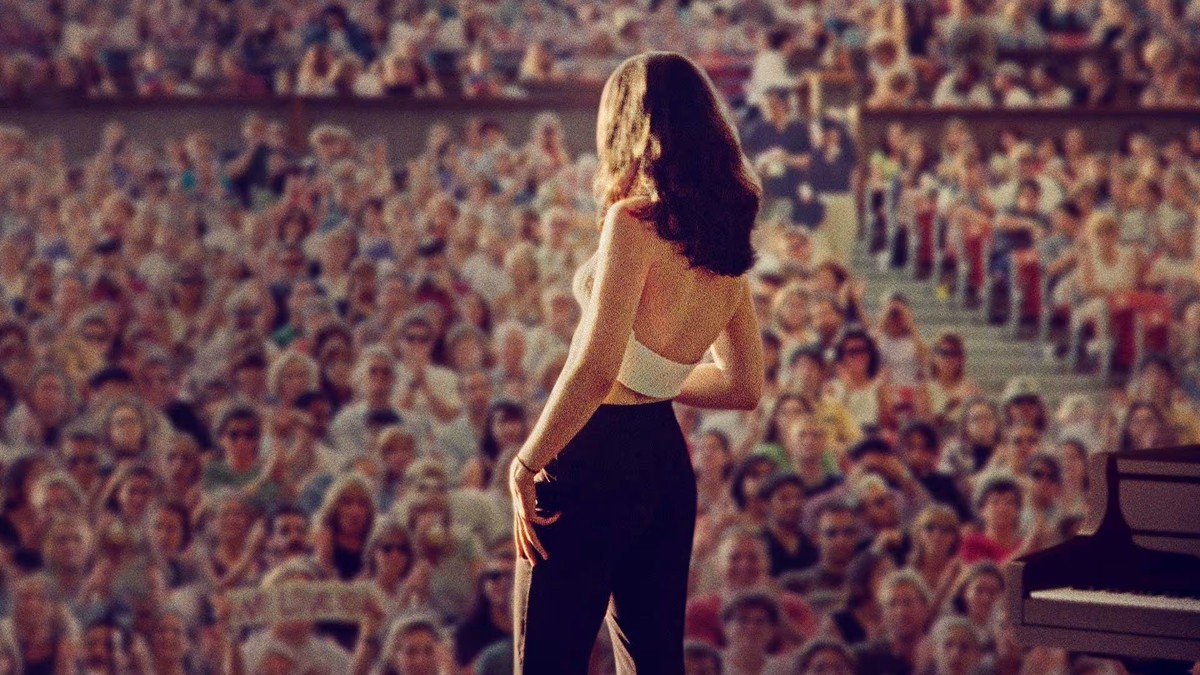
But there are more than testimonies. One of the successes of the film is the impressive treasure of images of the entire tour: on stage, in the backstage, among the public, in the organization’s offices… music journalist Jessica Hopper (author of the original seed of this documentary, an oral history of Lilith Fair for Vanity Fair published in 2019) is also a producer of the documentary, and commented in a recent interview that the key moment of the documentary was when they discovered those 600 hours of video that the organizers had patiently recorded and archived throughout the three years of this adventure. In the shots chosen for the film, it is incredible to be able to see Aimee Mann, McLachlan and Lisa Loeb sitting on a sofa chatting and laughing, the organizers dancing inside a bus after the concerts, Sheryl Crow performing with her idol Bonnie Raitt, or the unrepeatable Indigo Girls getting all the artists together to sing together on stage at the end of each night, in what Sarah calls at one point in the documentary “the best drug in the world.”
The idea that men didn’t listen to these artists is a lie.
The images of the audience are another treasure: the outfits, the happy atmosphere, all those shots of music fans with a smile on their face, dancing spontaneously, some crying for having found their place. Mostly women, but also many men, something that with the experience of the time I can say has not shocked me at all: it seems obvious to say it, but if your love for music was not contaminated by retrograde ideas, in the 90s you liked music without paying attention to gender issues: having been a big fan of Suzanne Vega and Sinèad O’Connor since the late 80s, and throughout the 90s successively of the Indigo Girls, 10,000 Maniacs, Mary Chapin Capenter, Aimee Mann, Juliana Hatfield, Emmylou Harris or Lucinda Williams (all artists who participated in the festival) attending this festival would have been a dream for me. As author Andrea Wariner comments in the Vanity Fair article, “in the mid-90s, women outsold men. The idea that men didn’t listen to these artists is a lie.”
And just as the documentary dismantles that myth, it directs the focus towards other diversities. Its director Ally Pankiw is queer and pays special attention, for example, to what Lilith Fair meant for the LGTB+ community. We see Brandi Carlisle recounting her attendance at the festival while she was still a teenager and describing the feeling of freedom, inclusion, and how important the experience was for her, just like the Indigo Girls as participating artists.
And as the documentary narrates the editions of 98 and 99 we see how this interest in diversity also extended to other areas: although the vast majority of the artists were white, in each new edition more diverse artists were incorporated, including genres such as country or black and urban music, which until then in the 90s had barely had a place in the festivals. Without going any further, the first concert of Missy Elliott’s career took place at the Lilith Fair in 1998. Nelly Furtado, Dido and Christina Aguilera also took their first steps on the smaller stages of the festival.
The documentary also records the political problems generated by the solidarity part of Lilith Fair: one of its groundbreaking ideas was to donate a dollar for each ticket sold to charitable causes chosen by the organization. For the most part, these were NGOs supporting battered women or family planning, including organizations in favor of abortion, something that in the cities of the southern United States raised eyebrows and generated protests, including bomb threats and various boycotts. In a very Canadian exercise in transparency, Sarah McLachlan gave press conferences in each new city, in which they had to endure aggressive questions about these issues, in addition to the expected misogynistic and insolent comments.
Lilith Fair represents the world we would like to exist now
The epilogue is bittersweet: Lilith Fair was the largest festival of the ’90s, bigger than Lollapalooza or Monsters of Rock, and could perhaps have continued for a few more years, but the level of involvement of Sarah and her team led to exhaustion at the end of the third year. A summer that was also that of the infamous ‘Woodstock 99’, an event that showed the other side of what a festival could be, and that unfortunately marked the beginning of the “bro-ification” of alternative rock at the hands of Korn, Limp Bizkit, and company. When you see the images of Woodstock at the end of the documentary, your heart sinks.
Before almost realizing it, the backlash against Lilith Fair fell like a stone: the industry was still led by the same people, and although many things changed for the better, by the beginning of the 2000s labels and radio stations had re-catalogued a good part of all these artists as AAM (Adult Alternative), relegating them to much more minority media and stations, leaving the alternative space occupied by male artists of the same age or older. All this also coincided with the arrival of the new prefabricated pop of Britney Spears, N’Sync or Jessica Simpson, which many of the artists also saw as a cultural reaction against it.
The impression that Lilith Fair was a bubble that lasted three or four years and then was punctured by the powers that be hangs over the final minutes of the documentary. The artists speak of a bittersweet and infuriating ending that led to that slow oblivion in the following years, the amnesia of something that was practically an anomaly. However, there is room for hope: first because of the increasingly growing interest in what it meant. As Liz Phair explains very well, “current nostalgia is because Lilith Fair represents the world we would like to exist now.” Other voices point out that something similar would be unthinkable now, but at the same time it would be more necessary than ever in the current situation of rampant sexism, homophobia and racism.
Perhaps as a way of hope, the final shots of the film show images of recent and massive concerts by Boygenius, Taylor Swift, Olivia Rodrigo, Beyoncé and Billie Ellish, about which music critic Ann Powers comments that “the atmosphere in these places is the same as what was experienced at Lilith Fair, and what was then criticized about the festival is now accepted” and concludes that it has finally come to the point that in music “women are at the center of culture.” If that is really so, Lilith Fair certainly contributed in a very important way. 8.
