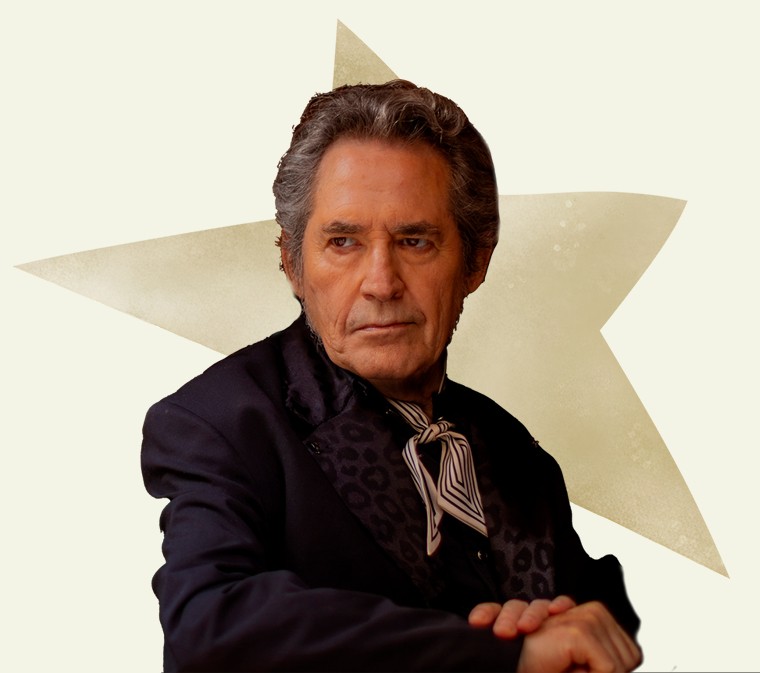
If you pay to see an artist’s concert, it is assumed that you have a minimal idea of what you are going to find. Maybe you don’t know all the songs, but you do know the hits. Maybe you don’t consider yourself a fan at all, but there is a minimum of sympathy. Maybe you love ‘Born In The USA’, but you don’t know it’s an anti-war song. Is this possible? Is a concert a good place to do politics? For many, the best.
For Miguel Ríos, who has described himself during his show at the Starlite Oeste in Marbella as a “political being”, of course yes. It all happened after the legendary singer took out a kifaya to call for “no to war” and genocide in Gaza, while also asking to “stop fascism before returning to what was before.” At that moment, part of the audience began to boo him: “We have come to hear you sing, not to do politics,” they shouted at him.
It is strange that Miguel Ríos’ audience is so reluctant to something like this, when the artist has already begun to share his political ideas with the release of ‘Hymno a la joy’. Whether his fans like it or not, it is the piece that made him become “aware of reality” and that would provoke songs of a more marked ideology in the years to come. This is how Ríos responded to those who had rebuked him: «How can I not do politics if I am a political being? How can I keep quiet because you don’t agree with me? Respect them like I respect yours. “I’m talking about humanism, not about colors,” said the 82-year-old artist.
Miguel Ríos must have thought, at that moment, that times had not changed that much. «In my youth, it was instilled in us at home that we should not talk about politics; Come on, don’t complicate our lives,” he said in an interview with elDiario.es. At his concert in Marbella, life became complicated, but the responsibility was not on him: “I came here to this stage and you knew who I was, and if you didn’t know, why did you come, man?”, responded the singer.
Yesterday they rebuked Miguel Ríos at his concert in Marbella for supporting the people of Palestine and getting into politics. This was his response: “I am a political being. The genocide must stop.” (Video: Mar Bassa 📹) pic.twitter.com/bg62MOSzRv
— Fonsi Loaiza (@FonsiLoaiza) July 26, 2026
If an artist’s discography is clearly political, why shouldn’t their concerts be too? After decades of songs like ‘Lost In The Flood’, ‘American Skin (41 Shots)’ or ‘Streets of Philadelphia’, are there still people surprised by how clear Bruce Springsteen is in his shows? What is certain is that many are not happy with it.
Jonathan Cain, Journey’s keyboardist since 1980 and defender of the Trump presidency in recent times, dedicated some hurtful words to Springsteen a few days ago: “People like him should shut up. Who cares? Make your art. “I try to leave politics out of my music,” he declared. Although he describes himself as an “intransigent conservative”, directly opposed to the ideas of the author of ‘Born To Run’, there are other examples of artists who would not vote the same as Cain at the polls, but who do agree with him on the role that politics should play in concerts.
If anyone has the authority to talk about what happens on stage, with six decades of experience, it is Mick Jagger. The legendary frontman gave his opinion on the subject during his visit to The New York Times podcast, stating that “it depends on where you are and what type of event it is.”
He argues that at festivals the public “does not necessarily come to see you”, although in his case this is hardly the reality. Still, he has a point: “I’m not saying they hate you, because otherwise they wouldn’t be there, but there are different levels of people in these audiences and you have to treat them slightly differently,” he explained.
For Jagger, concerts are spaces in which problems, of any kind, should be left at the door: «My job in music is for the audience to have the best time they can and to forget the real problems of the world. Their mortgages or whatever,” he continued. He defends that his mission is to make people “go crazy”: “What you don’t want to do is teach them,” he commented. Would you have Springsteen in mind?
Although The Rolling Stones’ latest album does contain political content, especially in its direct insults to Elon Musk, the British singer is not interested in expanding these ideas in his concerts. But in what situation, apart from a live show, does an artist have the opportunity to look his listeners in the eyes and explain his vision of the world directly? Isn’t this why we listen to music?
 Charging …