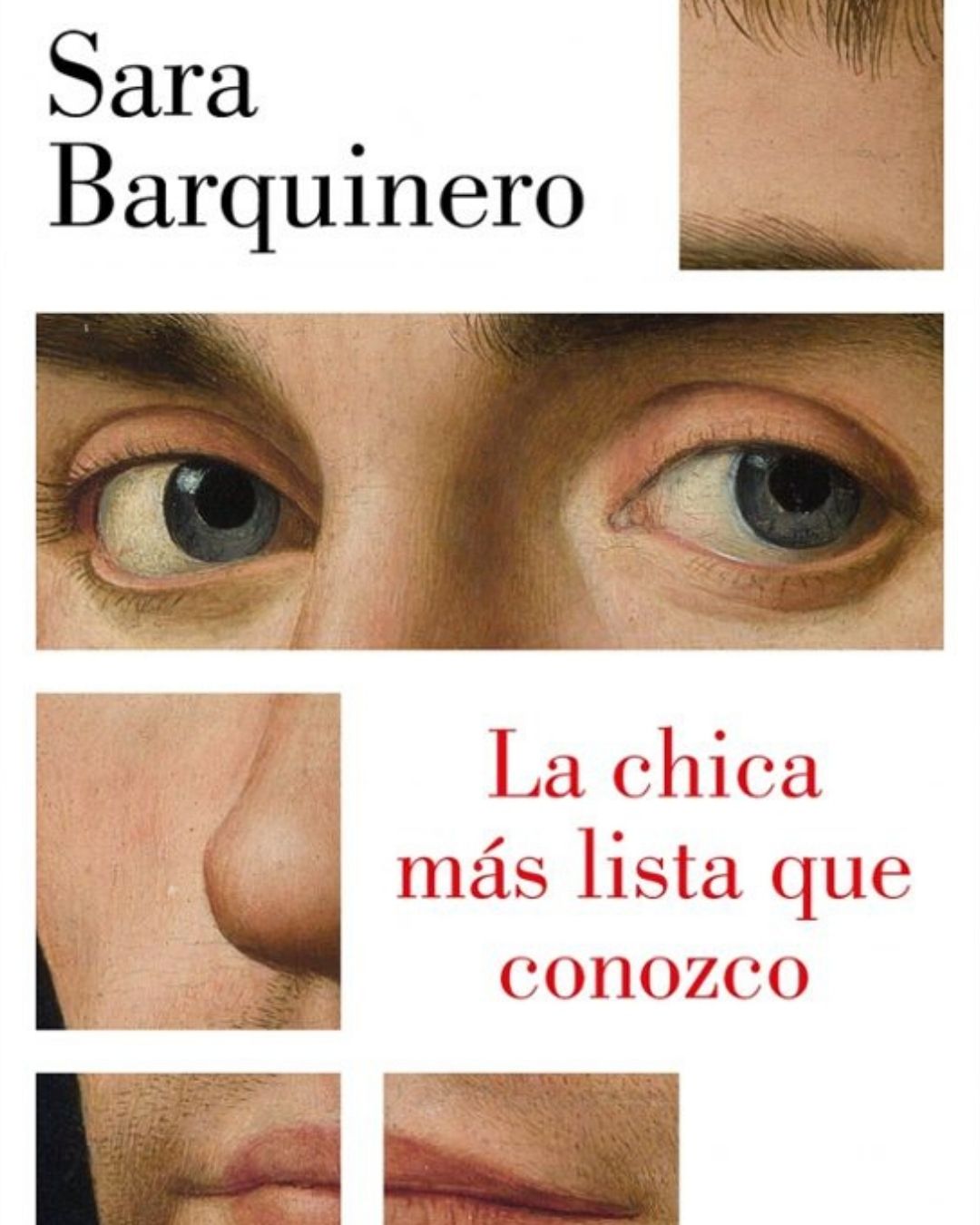
The smartest girl I know (Sara Barquinero)
After the success and recognition achieved by Sara Barquinero with ‘Los escorpiones’, expectations for her new novel were enormous. Something similar to what happens with Cristina Morales, who finally returns! this end of the year to fiction after the extraordinary ‘Easy Reading’, or, on another level of popularity, with David Uclés and his recent (and somewhat disappointing) ‘The city of dead lights’.
The first thing that stands out about ‘The Smartest Girl I Know’ (Lumen) is that it has nothing to do with ‘The Scorpions’, neither thematically nor narratively. Barquinero has written a novel about learning, about campus, with echoes of the extraordinary ‘The Wedding Plot’, by Jeffrey Eugenides (another who is making waves with his new book). Through a young woman from Valladolid who arrives at the Complutense University to study Philosophy, it portrays university expectations, friendship between women in a very masculinized environment and the abuses of power in the academic world. The second thing that surprises is its formal construction: the novel takes on the appearance of a philosophical treatise, with hypotheses, demonstrations, objections, digressions, abundant footnotes and even a juicy final bibliography. An approach that is as stimulating from an intellectual point of view as it is demanding for the reader, but whose ambition is rewarded by the brilliance of its reflections. 8.5.
Silicon Valley (Carla Nyman)

Carla Nyman could be one of those “smartest girls I know” that Barquinero talks about. They are two writers who, perhaps because they share a generation, references and interest in philosophy, have more than one point in common. In fact, the protagonist of ‘Silicon Valley’ (Reservoir Books), a proofreader of science fiction novels who barely leaves her apartment, chats with her dog Averroes and practically lives on the internet, could perfectly be a character from ‘The Scorpions’.
Narrated in the first person, the novel advances through a torrent of consciousness that mixes thoughts, fantasies, online conversations, philosophical digressions and a few missteps, until building a very unique literary universe. Under that eccentric and playful appearance, Nyman deploys a sharp and very funny critique of digital capitalism and the new forms of existence imposed by technology. Through cyberrelationships and the progressive dissolution of identity in virtual space, the author composes a philosophical fable that reflects on contemporary loneliness and the limits of humanity. Overflowing with imagination and intelligence, ‘Silicon Valley’ confirms Nyman as one of the most original voices of his generation. 8.
The Names (Florence Knapp)

Tremendous debut. Not only for its literary quality, but for what it counts. ‘The Names’ (Salamandra) is an enormously raw novel about abuse and sexist violence and how this conditions the life of an entire family. Its starting point is very attractive: based on the name that a mother decides to give her son, Florence Knapp develops three parallel narrative lines that imagine three different lives for the same characters. A premise that recalls films like ‘The Chance’ (1987), ‘Mr. Nobody’ (2009) or that jewel of Spanish cinema that is ‘Life on a Thread’ (1945).
Although the structure, with continuous jumps between stories and the presence of the same secondary characters in alternative realities, can be somewhat convoluted at times, the artifice ends up justifying itself. Knapp uses all three versions to explore the extent to which chance, seemingly insignificant decisions, and major historical events (the Great Storm of 1987, the Bataclan attacks, the Covid pandemic) shape our destiny and determine our existence. A very ambitious and disturbing first novel from an author who must be followed closely. 8.1.
A thousand things (Juan Tallón)

Just when I finished reading ‘A Thousand Things’ (Anagrama), on May 21, a news story appeared (DO NOT CLICK IF YOU HAVE NOT READ THE NOVEL!) that made my hair stand on end. Not only because of the terrible event itself, but because it reproduced with disturbing accuracy something I had just read in the novel. I already knew that this had happened before, but that coincidence, that unexpected fulfillment of the aphorism “reality is stranger than fiction”, left me even worse off than Juan Tallón’s story had already left me.
Set on the eve of the summer holidays, under unbearable heat, ‘A Thousand Things’ narrates the stressful last working day of a couple in a big city. One of those days with “a thousand things” to do before you can (if you can) do nothing. Tallón turns this “climb to Everest”, as the protagonist defines it, into an absorbing thriller of everyday life, where the accumulation of small tasks, setbacks and constant “I have to leave you, we’ll talk later” ends up generating unbearable tension. A fierce satire on our way of (without) living that shows that a slight crack in the daily routine is enough for everything to collapse beyond repair. 7.5.
Real cases (Yasmina Reza)

Yasmina Reza, author of such well-known plays as ‘Art’ or ‘A Wild God’ (adapted to film by Polanski), returns with a very curious and attractive non-fiction book. The result of more than fifteen years attending trials in French courts, ‘Real Cases’ (Alfaguara) brings together a succession of scenes inspired by real judicial processes, from especially brutal crimes to small everyday crimes, which transcend the mere chronicle of events and the true crime genre.
Narrated in the first person with the psychological acuity and fine irony that characterize Reza’s writing, ‘Real Cases’ turns the court into a privileged observatory from which to explore the contradictions and miseries of human beings. The author intertwines the stories of the accused and victims with personal memories and reflections on guilt, the passage of time or the fragility of existence. More than judging those who parade through the room: murderers, traffickers, swindlers, former presidents of the Republic… Reza tries to understand them and investigate what has led them to the bench. In this way, each process becomes an opportunity to delve deeper into the great theme that underpins all of his work: the mysteries of the human condition. 7.8.
Red sky over Glasgow (Alan Parks)

A good crime novel could not be missing. Among all the exciting novelties that have been published this year (‘The Sixth Messiah’, by Mark Frost, ‘The King of Ashes’, by SA Cosby or the new installments by Kate Atkinson, John Connolly, Colin Dexter, Louise Penny, Graeme Macrae Burnet…), I decided to start with ‘Red Sky Over Glasgow’ (Tusquets). I wasn’t wrong.
Alan Parks, creator of the popular series starring detective Harry McCoy, which began with ‘Bloody January’ (Tusquets, 2020), here inaugurates a new trilogy headed by Joseph Gunner, a former police officer recently released from the hospital after being injured in France during the Dunkirk evacuation. The Scottish author combines the crime novel with the historical recreation of two of the most relevant episodes experienced by Scotland during the Second World War: the devastating German bombings of March 1941 and the unusual secret flight of Rudolf Hess, Hitler’s lieutenant, who in May of that same year parachuted into Scottish territory in an attempt to negotiate peace with the United Kingdom on his own. Very entertaining. 7.3.
Elizabeth (Ken Greenhall)

A horror novel from the ’70s written by an obscure encyclopedia editor who decided to sign it with his mother’s maiden name: Jessica Hamilton? A forgotten author, who died in 2014, of whom only a couple of blurry black and white photographs circulate? A story told in the first person by a fourteen-year-old teenager that presents itself in this way: “I came to live with my grandmother a year ago, after killing my parents. I don’t want to seem insensitive. Let me explain it to you”? You have my full attention, Mr. Greenhall.
Lumen rescues from oblivion this small cult work, which had been out of print in Spanish for decades. I continue with the questions. Does ‘Elizabeth’ live up to the hype and the references with which it has been promoted, ‘Carrie’ and ‘We’ve Always Lived in the Castle’? Well no, of course. Hidden literary gems are like the Necronomicon: they don’t exist. Is ‘Elizabeth’ a good horror novel? Yes, without a doubt. Mostly for one reason: the uniqueness of your subjective point of view. A voice that is a mix of novice witch, twisted psychopath and perverse Lolita, so intelligent, biting and disturbing that it makes the reader constantly oscillate between fascination and discomfort. 7.
Albion (Anna Hope)

A bucolic mansion in the English countryside, a posh family reunited and three or four days ahead. Come on, the perfect setting for tensions to arise, secrets to surface and more sparks to fly than in the ‘Succession’ series. ‘Albion’ (Asteroid Books), a title that alludes to the old name of Great Britain (the “perfidious Albion” that Napoleon called), enters squarely into the country house novel, the typically English subgenre that Jane Austen practically inaugurated with ‘Mansfield Park’.
Anna Hope uses the codes of the country house novel to remove them like a gardener with a bulldozer. Under the guise of a family drama full of reproaches, inheritances and unfinished business, the author digs into the roots of class privilege and unearths the hidden miseries of the British colonial past. A choral novel, light and sharp, very well put together narratively, which shows that, even in the most idyllic landscapes, there are always corpses, real or symbolic, buried under a garden lawn. 7.
Rasputin (Antony Beevor)

“Rasputin, lover of the Russian queen,” sang Boney M. That is just one of the many hoaxes surrounding the figure of the famous Russian mystic. There’s more: crazy and dangerous monk, miraculous healer, shadowy conspirator, sexual depraved, “gifted” lover (his supposedly gigantic member is preserved in a museum in Saint Petersburg)… He even starred in a Hammer film, ‘Rasputin’ (1966), as if he were just another horror movie monster.
Antony Beevor weeds through all that tangle of sensationalism and falsehoods to ask the key question: how on earth did an almost illiterate Siberian peasant manage to become one of the most influential figures at the Romanov court, to the point of accelerating its collapse? With agile and very visual prose, the British historian manages in ‘Rasputin’ (Criticism) to combine the biographical portrait of a fascinating character with the chronicle of the decomposition of tsarism. An absorbing tale of increasing dramatic tension, filled with palace conspiracies, war, murder, lust and religious fanaticism. 7.7.
Odyssey (Homer)

Nolan is already a bit like the fan or the umbrella: he always releases his films in the summer. His monumental adaptation of ‘The Odyssey’ promises to shake the box office like Poseidon the ship of Ulysses. The networks have been burning like Troy for months: what if the design of the armor, what if the racial diversity of the cast, what if everything looks very dark and brown… If what we want is to have a more or less formed opinion and not seem like an X-mouth, there is nothing better than going to the original source.
Verse or prose? If, like me, you want to read Homer’s songs in hexameters translated from archaic Greek as much as watching an Uzbekistan-Republic of the Congo in the World Cup, there are prose versions that, according to those who know, translate the poem with great fidelity. The canonical translation in Spanish is that of Carlos García Gual (Alianza). However, I am going to recommend the classic English version by Samuel Butler. Not because I know how to appreciate them, of course, but because of the wonderful Blackie Books edition, which also includes Calpurnio’s illustrations and other texts inspired by ‘The Odyssey’, such as Margaret Atwood’s rereading from Penelope’s point of view and brief pieces by Nick Cave, Augusto Monterroso and Javier Krahe. 8.
