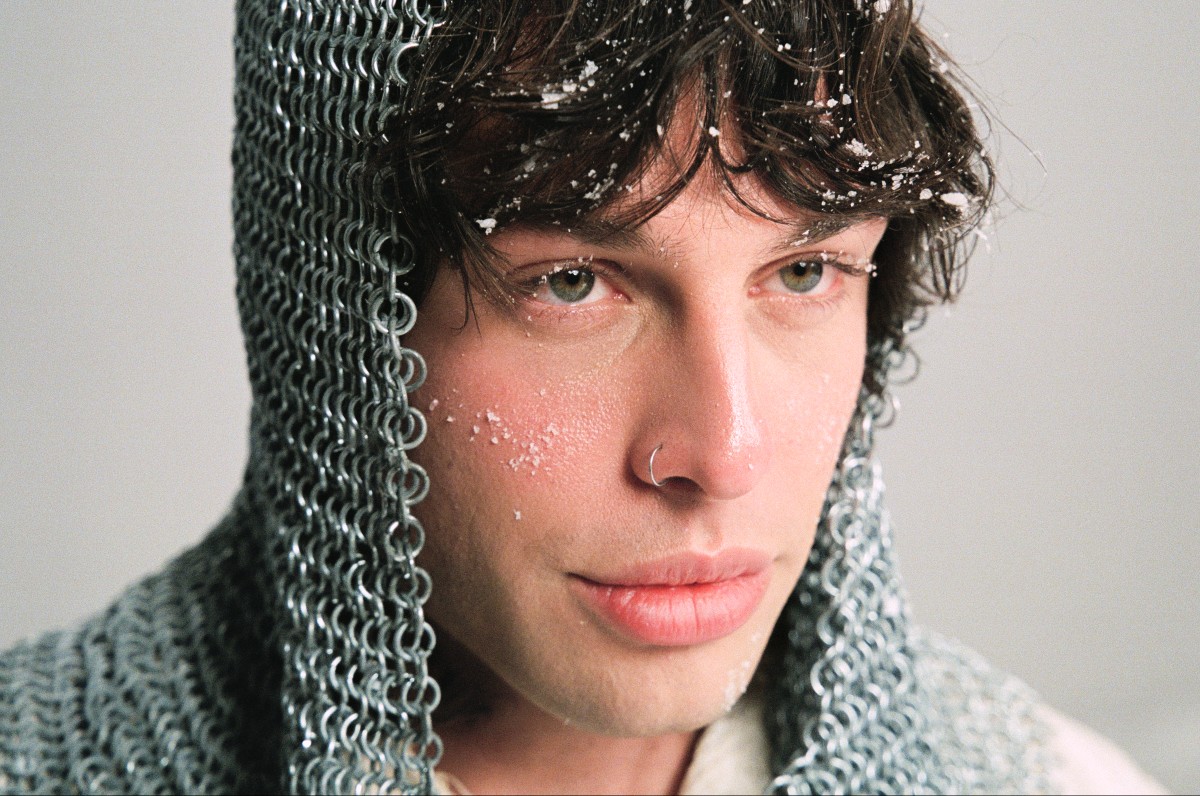
After 350 million streams on Spotify for ‘Amapolas’ (plus an extra 100 for its remix with Danny Ocean), Leo Rizzi continues his career. This week ‘Blue Bird’ happens with an album called ‘The Beauty of Flowers’ with a certain spiritual sense.
In the album, Leo Rizzi talks about love but also about religion and death, concluding that it is not possible to kill a musician because his songs will always remain. We spoke with the artist at the Warner offices in Madrid. The artist is preparing a tour of Mexico at this time. Details on their website.
In this album it seems that you talk about love, beauty and, in part, death. Would they be the main themes?
It does talk about that, but I think the essence of the album is more in tune with Byung-Chul Han’s phrase from which the name of the album comes: “The beauty of flowers is due to a luxury that is free of all economy.” From there everything unfolds. I think it speaks, above all, about love, but not only romantic love, but love in the broadest sense of the word: as devotion, presence or care.
There are more and more artists who talk about not only romantic love, but also other types of love, even friendship. Although sometimes it is difficult to identify it. Can you give me some examples of songs on the album that talk about love from another place?
‘Faith’, for example. It could be interpreted as a romantic love song, but it really talks about faith in a utopia. If you read the lyrics carefully, you realize that it is not a song about heartbreak, but rather it is about that utopian search, about the struggle with oneself and even with faith. It has that double reading quite clear.
It strikes me that you give precisely the example of ‘Faith’, because it refers a lot to something religious. Also, there is another song where you say “What is the importance of my religion?” or something similar. It seems that religion is also an important theme on the album, right?
Everything really comes from a reading by Byung-Chul Han. The first book of his that came to me was ‘The Disappearance of Rituals’. There he talks about looking at tradition again through religious rites, and I found it very interesting. At the same time, everything about Rosalía and a certain neo-Catholic movement or Christian imagery emerged. But, far from wanting to be within that wave, my approach to religion is more about seeking in it a tradition and a land that I think, in the current context, we are missing. A narrative that accompanies us in daily life and that is far from consumption and production. My relationship with religion goes more along those lines.
«More than the neo-Catholic movement, I am looking for a tradition that we are missing»
Do you think that today we are missing a foundation? Everything goes very fast: productivity, consumption… You, in addition, as an artist, are constantly aware of the news and the monthly listeners. Like, are you looking for something to hold on to that isn’t constant novelty?
Yes, the album was born precisely as a response to that. I think that the immediacy, the rhythms of consumption and production and the change in values that we are experiencing have led me to consider these things. And I think that this movement you speak of, that search for God or meaning, arises precisely as a reaction to all this. We need to reconnect with certain values, and religion has always been that place to which one clings: a way of living, a narrative that helps you not get lost. Otherwise, we end up subject only to performance, and that is outrageous.
Suddenly, even mentioning the possibility of an omnipresent God seems Martian. I had already forgotten about it since school, to be honest. Do you think this can be a topic in 2026?
I believe that God can change shape. What cannot become God is a ticket. Therein lies the problem. Regardless of whether there are more skeptical people or people with more faith in something unknown, I believe that human beings should not move only by producing and consuming. And that is where the need arises for a narrative that gives us values. I’m not talking about creating a God to justify our evils and our goods, but about finding a way to go through life in a more human, healthier, even more fun way, and celebrate a little that we are alive.
«God can change form. “What cannot become God is a ticket.”
In any case, ‘Faith’ has a second half in which the song changes completely and a kind of monastic choir or something similar enters, which reflects quite well what you want to convey.
‘Faith’ speaks of devotion to something one believes in, even if it is utopian. It is the path you decide to choose. And at the end I invited a friend who has also been a teacher for me: Manu Om, a singer closely linked to devotional singing and mantras. He works a lot on bhakti. I wanted to naturally include Hanuman, who is a Hindu god, and also a mantra dedicated to him: “Hanumate Namah.” I asked Manu what he thought and if he wanted to participate in the song. And there that second part emerged, which works almost like an outro and that reminds me a lot of the songs that I experienced in their classes and ceremonies. In some way, it also represents a return to my beginnings in music.
Even so, it is almost an exception within the album. The rest don’t go that far in that direction. Have you ever considered taking that idea to the extreme?
Yes, I thought: “This aspect of the album is situated in religion, faith and Hinduism, so I’m going to take it to the maximum.” I think it’s a rarity within the album, but a rarity that makes sense.
Do you see it as an album close to progressive rock or does it seem more like a pop album to you?
I couldn’t tell you. I think it does have something progressive, because it doesn’t follow structures or rhythms that are so common in current pop. I listen to it and I think it’s not pure entertainment. There are songs with very long dynamics and changes in intensity that would probably bore part of the audience more accustomed to fast consumption.
You have lived in various places, you have traveled a lot… Do you feel close to a Spanish scene like that of Carlos Ares or Rufus T. Firefly, or are your influences more Anglo-Saxon and the 70s?
I am influenced by many very different things. But I can see myself in an alternative or underground pop scene in Spain, alongside artists like Rufus or Carlos. Although I have always looked a lot towards Anglo-Saxon things – Radiohead, for example -, also towards Uruguayan folklore or artists like Fernando Cabrera. But yes, if I have to relate to something in Spain, it would be more there.
Which song has the most influence from Uruguayan folklore?
‘Cats’. It is inspired by ‘For example’, by Fernando Cabrera and Eduardo Mateo, included on their 1987 album of the same name. I was inspired above all by the guitar riff, which has something very rhythmic.
The song “Samba” on the album is like a “bug.” Is it there? Does it make sense?
Yes, it is literally a bug, a hidden track. It does not appear on the Spotify version and, for now, it is only on vinyl.
It is one of the ones I liked the most. I love it when a different beat suddenly appears and breaks up with the rest of an album.
Yes, it also came out a little from that reference to the Río de la Plata, to Eduardo Mateo and that whole mix of samba and bossa nova. I wanted to do something like that, but it had no place within the album as a central theme. It had to be more of a little window.
Don’t you see yourself making an entire album of samba or rhythms like that?
Yes, I imagine myself doing something with a lot of reference to bossa nova, but this album asked for something else.
Was it important for you to make an album more focused on a specific style?
Completely. I wanted to make something coherent, that you would listen to any song and feel that it belonged to the same album, and not that one song was super electronic and the next a bossa nova.
«We artists are a little crazy: today we want to do one thing and tomorrow the opposite»
In recent years that idea of cohesion seems to have been lost a bit.
Yes, because now the artist has much more access to the means of production and also acts as a producer. And we artists are a little crazy: today we want to do one thing and tomorrow the opposite. I think that in that productive speed sometimes we get a little lost. To me, cohesion shows focus.
You’ve also very carefully sequenced the poppier parts of the album. Topics like ‘New Era’ or ‘Nuclear Year’ appear every three or four songs.
Yes, I was trying to find the moments where the rhythm could drop a little to put a more uptempo song in there.
For you, does the rhythm slow down and the album become long?
The album does not have the ambition of being listened to in one sitting. The songs are the ones I liked and that’s it. I didn’t intend to make an album designed to be consumed in an afternoon, but rather one that would be discovered little by little, so that everyone gets the song that needs to come to them.
Are ‘New Age’ and ‘Nuclear Year’ among your favorites?
My favorite I would say is ‘Eyelids’. I really like ‘Nueva Era’ because it is somewhat reminiscent of classic Spanish pop-rock, even something by The Police. But my favorite is ‘Eyelids’. I don’t know if it was pure onanism, but I love the guitar riff that came out there.
How has it been working on the entire instrumental part? There are many arrangements: winds, strings, Spanish guitars, like in ‘Halo’…
It was a pain, because we wanted to record everything with professional musicians and we ended up working with about 300 tracks. RYO are two kids with a composer and producer mentality, and I also function like that: composing, producing and arranging. There was no gap that we did not want to fill with some detail. Then Andoni Narváez and Cristian Delgado joined, who are also musicians and composers. And, luckily, Rubén Montes managed to give space to everything in the mix. The strings and winds add a third layer that makes the album very enveloping and maximalist.
Do you think the album represents a sad or happy stage in your life?
I wouldn’t say sad or happy. Rather, it is a very contemplative album. It has everything: ‘Samba’ is very playful, while ‘Fe’ is darker. Maybe the balance falls a little towards the melancholic, but above all I see it as a reflective album.
«You can’t kill the artist, because his songs remain»
There is also a kind of escape from death, right? Besides the song with Love of Lesbian, there is another moment where you say something like “even if they bury me, we will always be alive.”
‘Nobody can die here’ was born from a somewhat traumatic process within the industry, from facing its darkest part. And from there comes the idea that you can’t kill the artist, because his songs remain. In ‘Invisible Cross’ I talk about that.
But who has tried to “kill you” within the industry?
People who did not obtain the benefits I expected from my project. And you meet people who, when you stop caring, try to bring you down.
But you’re doing well, right? Especially after the viral OT on TV, right? At what point have you been “dead”?
It’s not like they literally killed me. It is more of a manifesto against that attempt. When you see that someone wants to put stones in your way, you think: “Don’t play with this.” It goes more there.
And are you okay now? You’re at Warner and everything seems to be going well.
Yes, yes, everything is fine.
I was also asking you about the ‘Amapolas’ viral. Has it had a lot of impact on you? Are you sick of the song?
It’s the evil of any artist: having a viral hit and feeling like your entire repertoire is constantly competing against that ceiling. But I’ve learned to take it more calmly. It was a virality born on TikTok and, when something like this happens, it gets completely out of control. It suddenly rings in Thailand, you know?
But, ultimately, that’s better than not having any hits. It seems that many artists experience it almost as a trauma. Radiohead still hasn’t gotten over ‘Creep’.
It is a duality. On the one hand there is your normal life, when you get out of the industry and become an ordinary person again. But then, within the circuit, in the dressing rooms, there is a lot of talk about these things. We all feel that we can do more or that we want to go further.
But you keep playing the song.
Yes of course. And I love it. I think it’s a beautiful song and I’m very proud of it.
