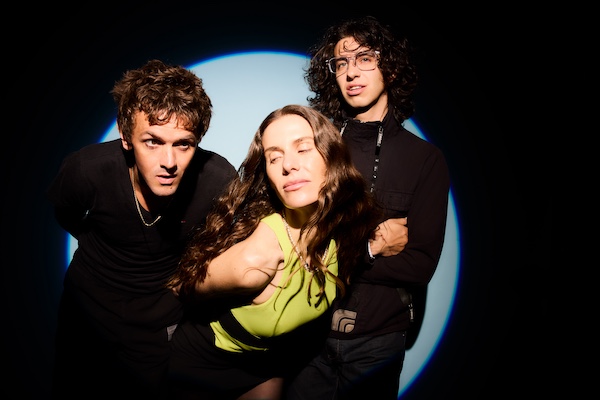
bar italia are about to arrive in our country to perform this Thursday, October 23 at La (2) de Apolo, Barcelona; and on Friday, October 24 at the Sala Mon in Madrid. Tickets, at Primavera Tours. Taking advantage of the hook of their recent single ‘Fundraiser’, we interviewed the trio in a hotel in the capital during a promotional visit.
Sam Fenton, Nina Cristante and Jezmi Tarik Fehmi (pictured left to right) defend their new album, ‘Some Like It Hot’, named after the Billy Wilder classic. Of course, not as much fun as in ‘Con skirts ya lo loco’ you will find in an album that talks about romance, intrigue and self-discovery.
I was expecting a very fun album because ‘Fundraiser’ is a pretty fun single, and because of the album title. But it’s not, right?
Sam: It’s definitely not as fun as the titles because we like to put in pretty silly titles. We have fun and we enjoy the joke, as a contrast, to recontextualize or resituate what is usually a serious song. There is humor in our music, of course, but it’s not something to laugh out loud about…
Is this song about a stalker?
Sam: I like hearing people’s interpretations because we don’t talk about our lyrics with each other. So we don’t plan what they mean, we let them speak to you for themselves. But that doesn’t mean you’re not right because we spend our lives together and there is a kind of symbiosis in our subconscious. So it’s not a complete fabrication on your part, but we never say things like “let’s write a song about a stalker.”
Jezmi: My part is literally about a stalker.
Nina: Mine is about leaving something behind. But it’s only part of the song.
Why don’t you talk about the lyrics among yourselves?
Nina: Sometimes I asked them about their parts, I like to know what they mean. But they don’t talk about it much, so I’ve stopped doing it. It has become like our culture.
Sam: The reason I don’t is because I like the idea that someone might say more even than they intended, so I’m much more interested in that than conscious reality. Sometimes you do things you don’t know you’re doing. So if I ask what the intentional meaning behind something is, I may be limiting the song.
Jezmi: In a more practical sense, I’m much slower at writing lyrics than the two of them. So if I ask them too much, it influences me too much. I like the accidental marriages that come from this, like the stalker thing. I think it’s fun. Because I haven’t thought about it that much, nor have I given it that much importance. It’s okay to say whatever without being influenced by anyone else.
Going back to the first question, do you think the album is sad? For example, the final track, ‘Some Like It Hot’? It sounds like something is wrong.
Nina: Like a doomsayer?
Sam: I think there is something uplifting. It’s not sad. It’s “I don’t give a shit.” It’s empowering.
Nina: This song is like it doesn’t let you go and there’s something intoxicating about it. Another person walks in and I don’t think it’s sad. I think it’s cathartic and it’s one of the things that still resonates with me about the album, even after being so involved in its creation. It still sounds fresh and has an emotional impact. There are no masks in that song for me.
Sam: I’m talking about not being able to see life the way I saw it when I was little. So yes there is a sadness in that. But the emotion he had while singing it was true passion, almost warlike. How to embrace that again. He has a lot of mixed emotions.
Something like this happens to me listening to Fontaines DC, regardless of what Grian sings, it all seems very melancholic to me. Like something is wrong in the world. For example, it happens to me with ‘Marble Arch’.
Sam: Yeah, I can relate to that, but not necessarily in a political or satirical sense. It may be something that is wrong in the world or in human nature, or a particular human quality that I see in myself or other people.
“The reason you make music is because you can’t reduce it to words”
I was asking because people in their 20s and 30s feel a little discouraged right now in Europe… Difficulties paying rent or, in your case, going on tours.
Sam: It’s the context, of course.
Jezmi: It’s our life.
Sam: We talk about the context we’re situated in and what’s inside, like interactions with people. Do they satisfy your soul? Do the people around you fulfill you? I don’t know about your case, but in mine it is there.
Jezmi: But the way you relate to people is also affected by that. But obviously we are happy…
Nina: I am very careful to make a closed statement that aims to summarize an album that has been created with a lot of magic, without intentions, for which we cannot take all the responsibilities. The reason you make music is because you can’t reduce it to words, that’s what music is for. So everything has many, many facets. It has many different things. What you say is true, but for me it oversimplifies things a little.
«Brexit has made things more difficult in London»
Do you live in London? Is creative life rich there?
Nina: It’s very depressing… We spend little time in London right now because we travel a lot, but it’s our home base. Sam is from London, Jezmin is from the suburbs, and I’m from Rome. I have lived there for a long time, and I think it has very difficult things, I think it is a difficult city to fight with. But it is also one of the most exciting cities in terms of culture and in terms of the amount of different things there are. If you come from a place like Rome, which has an exquisite atmosphere, but of only one type, you will be surprised by how many different things happen in London. But I’m not going to say it’s perfect.
Are you in a good cultural moment?
Nina: He has. Personally I think Brexit has made things more difficult because a lot of rich people have moved there. I don’t want to say that only a certain type of people should be in London, but there is a certain sector that is overstretched, as the welfare state has been dismantled. So the place has become more mannerist than habitable. And that, unfortunately, whether you like it or not, has a strong impact on the authenticity of the scene.
Tell me about the production of the album, how did you work on it? For example ‘Rooster’, which adds various instruments.
Sam: Part by part. We did like sections until we realized it needed a change, so I played a new section.
Jezmin: I wrote the guitar part three months before, I played it to Sam and he started making chords, and we ended up recording it.
Nina: I remember playing a piano.
Are you fast at writing?
Nina: A lot.
Jemin: We can find 40 songs.
Sa: ‘Fundraiser’ was very fast and ‘Rooster’ too, as far as I remember.
‘Plastered’ and ‘bad reputation’ have a less Anglo, different, even a little Latin groove. Do you listen to music from outside the UK?
Sam: Yeah, we realized it could be like a slow rumba. I know what you mean!
Nina: Something like Nelly Furtado came to mind.
Sam: I’d kill myself if I only listened to British music.
Jezmin: There’s something very American about our sound, kind of West Coast.
“I would kill myself if I only listened to British music”
Do all three of you listen to the same albums? Are the three of you very rockers?
Jezmin: We all have different tastes, I’m not the one who plays all the indie records, but I don’t think they do either.
Nina: I like hip hop. Maybe more than them.
For example, I am surprised by the influences on Wolf Alice, you see them and they look like a grunge group from the photos… but then they are not so much.
Nina: You don’t have to make music that resembles your influences. In fact it is very healthy not to do it.
Sam: I think we’re happy that rock is our medium, and then that, as you say, there are ties to other things. But we never use references in an obvious way. We like things to come up, but we don’t say: “let’s put something Latin here!” We stick to a kind of tradition and from there we let strange influences appear. Instead of doing fusion, we have a framework, and we let things come in.
«Some groups without a girl can be amazing because of that. “They are real freaks and only they can create this half-incel cultural bubble that is probably very toxic and not necessarily positive, but musically, it produces something strange and powerful.”
I’ve talked about Fontaines DC, where a boy sings, and Wolf Alice, where a girl usually sings. You have everything… Are you aware of the personality it gives you? You are not the typical group of boys, “without friends.”
Sam: We carry it naturally. Some girlless groups can be amazing because of that. They are real freaks and only they can create this half-incel cultural bubble that is probably very toxic and not necessarily positive, but musically, it produces something strange and powerful. I am not “anti that”, but thank God we are not that. I also like “girl groups” that I can’t imagine with boys. For example, imagine Sugababes with a boy.
Nina: Or Shangri-La’s.
Jezmin: I’m glad I’m not that, too. And there is a practical reason why we are not that and it is because many musicians know each other through music, which is a world dominated by men. But we have met through art, which is a predominantly feminine world.
Nina: And you have girl friends.
Jezmin: The truth is that many colleagues do not have…
Sam: It’s natural for us, but we don’t think much about gender. Regarding the balance of voices that you tell us, we were not aware of it until we started doing interviews and people told us. That it was unique to sing with three voices.
Nina: It’s also something that happens in rock. In hip hop it is very common to have three voices. Suddenly a rap comes out that has nothing to do with the above. And you’re asking me about the contrast between masculine and feminine, but Sam and Jezmin’s voices have nothing to do with each other. It’s never like a duet.
Jezmin: People are used to groups where this is done, each singing member singing their songs, like in Fleetwood Mac. I don’t know, but ‘Some Velvet Morning’ is one of my favorite songs, and if you think about it, it’s like 2 different songs in 1.
Sam: There’s something weird there and it’s amazing.
