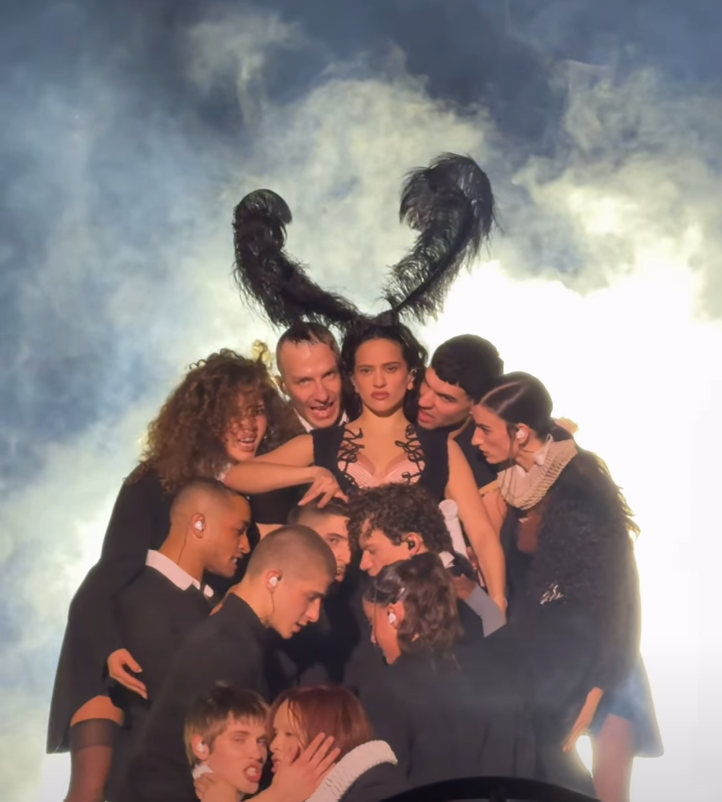
The use of playback at concerts usually generates controversy, unless you have assumed it because you are a fan of Britney Spears, and it is usually justified for different reasons. Artists use it when they perform choreography at the same time, when they fall ill but are forced to perform or, in the case of television performances, when the networks themselves require it to guarantee the quality of the live show. Since the 60s it has been implemented in television performances. Since then, numerous musicians have resorted to pre-recorded tracks in their concerts for a thousand and one reasons. The difference between playback and pre-recorded is relevant, since pre-recorded “intends” to be direct and playback does not.
In recent weeks, this controversy has affected Rosalía -although what controversy does not affect her-, who is said to have resorted to playback during her performance of ‘Berghain’ at the BRIT Awards and also at specific moments of her recently released tour. Part of the audience points out differences in volume and breathing, for example in the final phrase of ‘Mio Cristo Piangi Diamanti’ in Lyon. For some, the playback is clear and evident because the vocal take is too similar to that of the song published on ‘Lux’; For others, it would be impossible for a vocalist like Rosalía not to sing live. It’s unthinkable.
It is impossible to know if Rosalía uses playback at specific moments of her concert unless she confirms or denies it herself or someone on her team. But it should not be a cause for disappointment or controversy either, since he sings live for most of the show and can use this tool in specific phrases for different reasons, as all or almost all pop artists do. Perhaps he does it to avoid premature vocal fatigue, recommended by his doctor, knowing that vocalists like Adele have ended up undergoing surgery; or because that part doesn’t quite fit live. Furthermore, it is an operatic fragment in which she is making a special effort with her vocal cords, since she is not trained in opera.
@rosaliavtspain ROSALÍA performing •MIO CRISTO PIANGE DIAMANTI• at the start of the LUX Tour, tonight in Lyon. 🪽 #concert #performance #tour #rosalía #fypシ @La Rosalia ♬ original sound – rosaliavtspain
The use of playback is more widespread than the public believes because the artists’ work also consists of constructing an illusion of authenticity. This is where pre-recorded recordings come in, which are usually vocal takes recorded with differences from the original recording, so that it sounds different and seems direct. As YouTuber musicologist Jenn All points out, “the pre-recorded recordings are made just so that you notice those differences and, if there is playback, you sing over it so that the entire vocal apparatus is involved.” It’s a common trick for artists and it doesn’t mean their voices aren’t real.
On social networks, the playback is criticized as if its use represented a betrayal of the public or as if any artist who uses it were Milli Vanilli. However, its use could be assumed more naturally rather than interpreted as a hoax. Unless Rosalía – or any artist – can sing two or three hours almost every day during a tour of months or even years without her voice suffering – something extremely difficult – it should not be controversial that she and other artists resort to this tool for artistic or health reasons. In 2026, it shouldn’t be a debate.
